Classify
Classify
Designed a flexible, user-centred platform to simplify how schools track student progress
Designed a flexible, user-centred platform to simplify how schools track student progress
Context
Context
Group project in final year
Group project in final year
Duration
Duration
1 year
1 year
Team
Team
Group of 6
Group of 6
check out the website
The Challenge
The Challenge
Primary school teachers often struggle with effectively tracking student progress due to rigid, clunky systems that are not designed with their workflows in mind. These tools tend to be time-consuming and heavily reliant on manual data entry, making the process inefficient and taking valuable time away from teaching.
Primary school teachers often struggle with effectively tracking student progress due to rigid, clunky systems that are not designed with their workflows in mind. These tools tend to be time-consuming and heavily reliant on manual data entry, making the process inefficient and taking valuable time away from teaching.
Research & Discovery
Research & Discovery
We conducted over 30 interviews with primary school teachers and headteachers to understand the current landscape and pain points.
We conducted over 30 interviews with primary school teachers and headteachers to understand the current landscape and pain points.
Users
Users
The users are those at the heart of school operations - teachers managing the day-to-day realities of the classroom, and headteachers overseeing performance, priorities, and outcomes across the whole school.
The users are those at the heart of school operations - teachers managing the day-to-day realities of the classroom, and headteachers overseeing performance, priorities, and outcomes across the whole school.
Teachers
Teachers
Goals
Goals
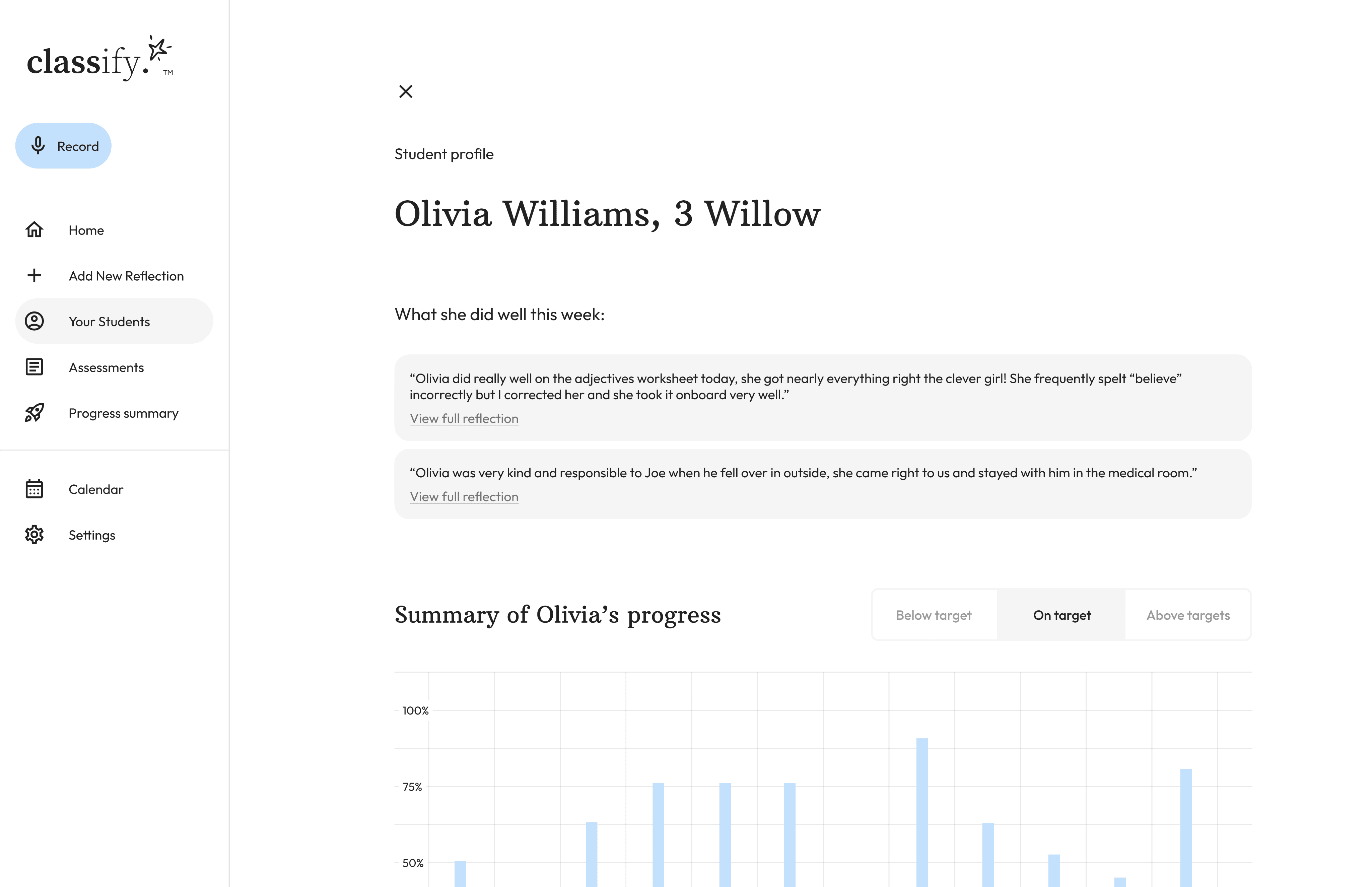
Easily take note of feedback on-the-go
Easily take note of feedback on-the-go
Identify students who need extra support early
Identify students who need extra support early
Track academic and personal student progress
Track academic and personal student progress
Pain Points
Pain Points
Feedback cannot be given on-the-go
Feedback cannot be given on-the-go
Data entry is a manual & time-consuming process
Data entry is a manual & time-consuming process
Tracking is spread across multiple platforms
Tracking is spread across multiple platforms
Headteachers
Headteachers
Goals
Goals
Gain an overview of pupil progress
Gain an overview of pupil progress
Streamline tracking and payments
Streamline tracking and payments
Ensure no child falls through the cracks
Ensure no child falls through the cracks
Pain Points
Multiple platforms and payments to manage
Struggle to get actionable insights from data
Risk of missing important concerns
Key Insights & Actions
Key Insights & Actions
Data entry must be effortless and intuitive to support consistent daily use
Data entry must be effortless and intuitive to support consistent daily use
Teachers are inputting data frequently, often under time pressure, so even small friction points can lead to inconsistency or avoidance. Streamlined, low-effort interactions are key to maintaining accurate and up-to-date records.
Teachers are inputting data frequently, often under time pressure, so even small friction points can lead to inconsistency or avoidance. Streamlined, low-effort interactions are key to maintaining accurate and up-to-date records.
The system needs to reduce the need for multiple tracking tools
The system needs to reduce the need for multiple tracking tools
Schools often have to track a wide range of data - academic progress, behaviour, interventions - leading them to rely on multiple separate systems. This creates fragmentation, added cost, and inefficiency, highlighting the need for a more unified approach.
Schools often have to track a wide range of data - academic progress, behaviour, interventions - leading them to rely on multiple separate systems. This creates fragmentation, added cost, and inefficiency, highlighting the need for a more unified approach.
Clear, reliable overviews of each pupil’s learning journey are essential
Clear, reliable overviews of each pupil’s learning journey are essential
Both teachers and leaders need to quickly understand how a pupil is progressing over time. This requires data to be presented in a way that is coherent, contextualised, and easy to interpret at a glance.
Both teachers and leaders need to quickly understand how a pupil is progressing over time. This requires data to be presented in a way that is coherent, contextualised, and easy to interpret at a glance.
Data should be easily analysable at a whole-school level to support strategic decision-making
Data should be easily analysable at a whole-school level to support strategic decision-making
Headteachers rely on aggregated data to identify trends, gaps, and areas for intervention. The system should enable efficient analysis across classes, cohorts, and time periods without requiring complex manual work.
Headteachers rely on aggregated data to identify trends, gaps, and areas for intervention. The system should enable efficient analysis across classes, cohorts, and time periods without requiring complex manual work.
Decisions & Product Direction
Decisions & Product Direction
1
Dictation is the primary way for teachers to record reflections
Dictation is the primary way for teachers to record reflections
Teachers are the primary day-to-day users, responsible for capturing and updating student data. Any solution needs to fit seamlessly into their routines - quick, low effort, and intuitive - so tracking doesn’t become an added burden.
Teachers are the primary day-to-day users, responsible for capturing and updating student data. Any solution needs to fit seamlessly into their routines - quick, low effort, and intuitive - so tracking doesn’t become an added burden.
2
Automatic classification against curriculum targets will greatly save time
Automatic classification against curriculum targets will greatly save time
Reflections are mapped to curriculum standards, allowing tracking grids to be automatically prepopulated. This saves teachers significant time, particularly in more subjective subjects like PE and art.
Reflections are mapped to curriculum standards, allowing tracking grids to be automatically prepopulated. This saves teachers significant time, particularly in more subjective subjects like PE and art.
3
All tracking needs should be managed in one platform
All tracking needs should be managed in one platform
Schools need a single platform that supports all areas of student development, including academic progress, personal growth, and social development. Bringing this tracking into one place gives teachers and school leaders a more complete view of each child’s learning journey.
Schools need a single platform that supports all areas of student development, including academic progress, personal growth, and social development. Bringing this tracking into one place gives teachers and school leaders a more complete view of each child’s learning journey.
4
Filters and automatic report generation are more important for senior leadership
Filters and automatic report generation are more important for senior leadership
Headteachers need to filter progress data across different student groups, generate reports at any time, and access clear, data-backed insights to support decision-making.
Headteachers need to filter progress data across different student groups, generate reports at any time, and access clear, data-backed insights to support decision-making.
Solution
Solution
1
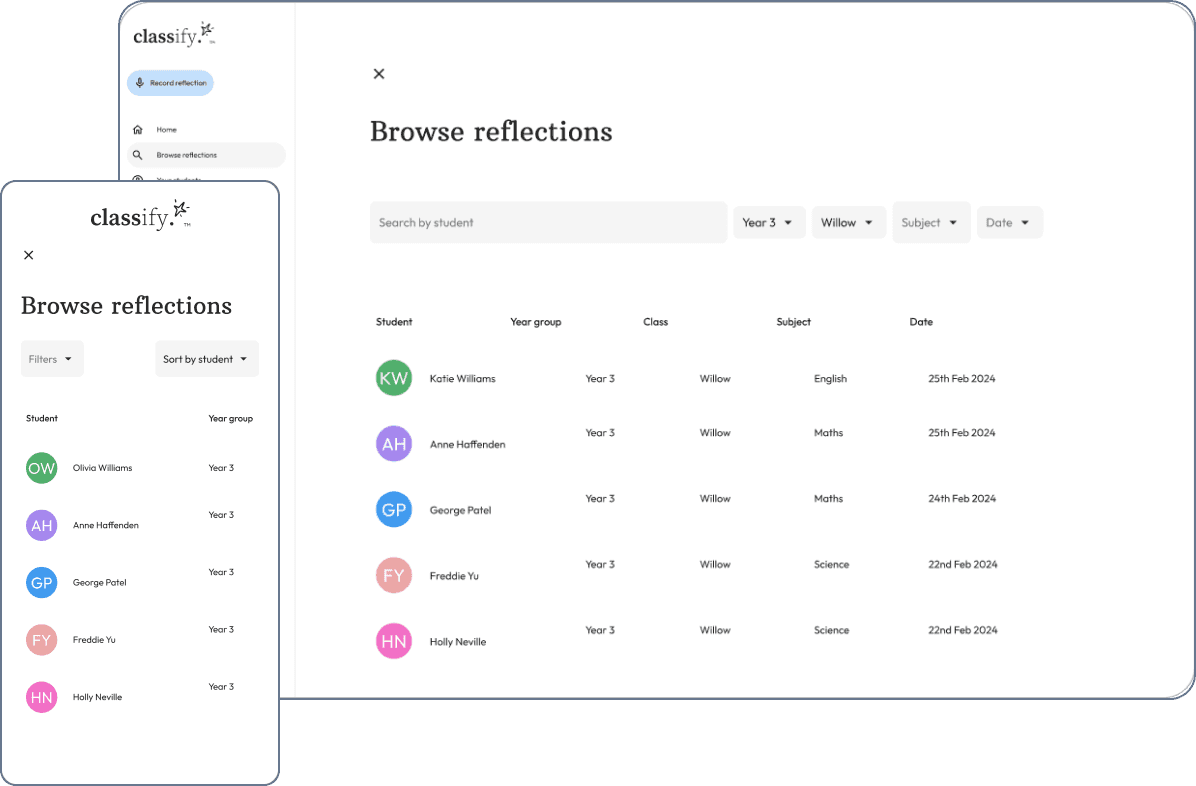
Teachers can make reflections in any form that they prefer
Teachers can make reflections in any form that they prefer
Teachers can record reflections in the way that works best for them — through voice notes, quick in-lesson observations, or end-of-day writeups. With a mobile-friendly platform, reflections can be captured anytime, anywhere.
Teachers can record reflections in the way that works best for them — through voice notes, quick in-lesson observations, or end-of-day writeups. With a mobile-friendly platform, reflections can be captured anytime, anywhere.
2
Actionable, meaningful insights are provided based on reflections
Actionable, meaningful insights are provided based on reflections
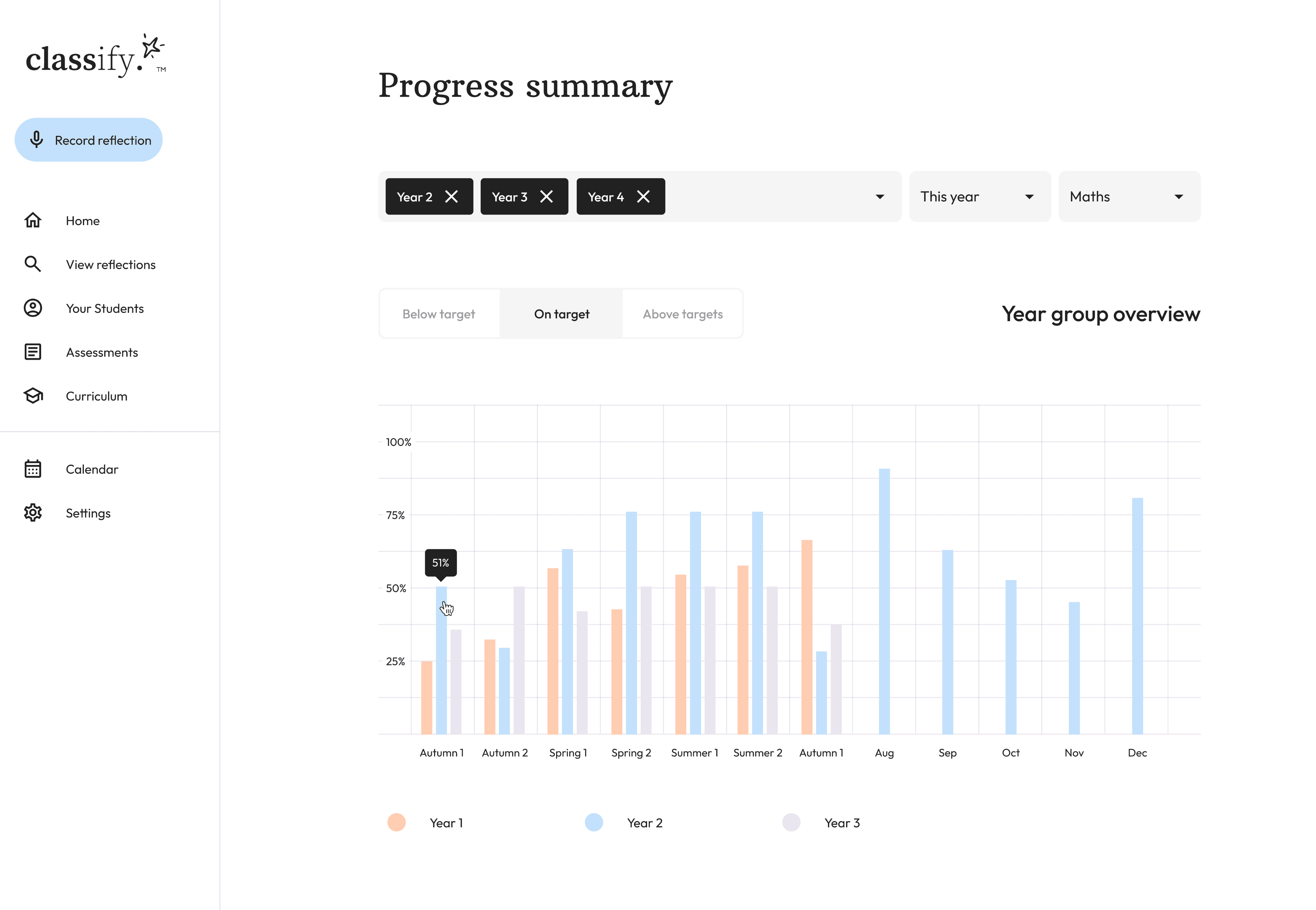
Student progress is more than just numbers on a screen. Classify combines data management with meaningful, human-centred insights, helping teachers understand progress in context without manually analysing large amounts of data.
Student progress is more than just numbers on a screen. Classify combines data management with meaningful, human-centred insights, helping teachers understand progress in context without manually analysing large amounts of data.
3
Teachers can track individual pupils, classes, or key stages at a glance
Teachers can track individual pupils, classes, or key stages at a glance
Teachers get real-time insights on pupils, classes, groups, and cohorts, all synced with their school’s LMS. This enables them to quickly spot trends, implement timely interventions, and track their impact over time, supporting more informed, data-driven decision-making and continuous improvement.
Teachers get real-time insights on pupils, classes, groups, and cohorts, all synced with their school’s LMS. This enables them to quickly spot trends, implement timely interventions, and track their impact over time, supporting more informed, data-driven decision-making and continuous improvement.
Positioning & Differentiation
Positioning & Differentiation
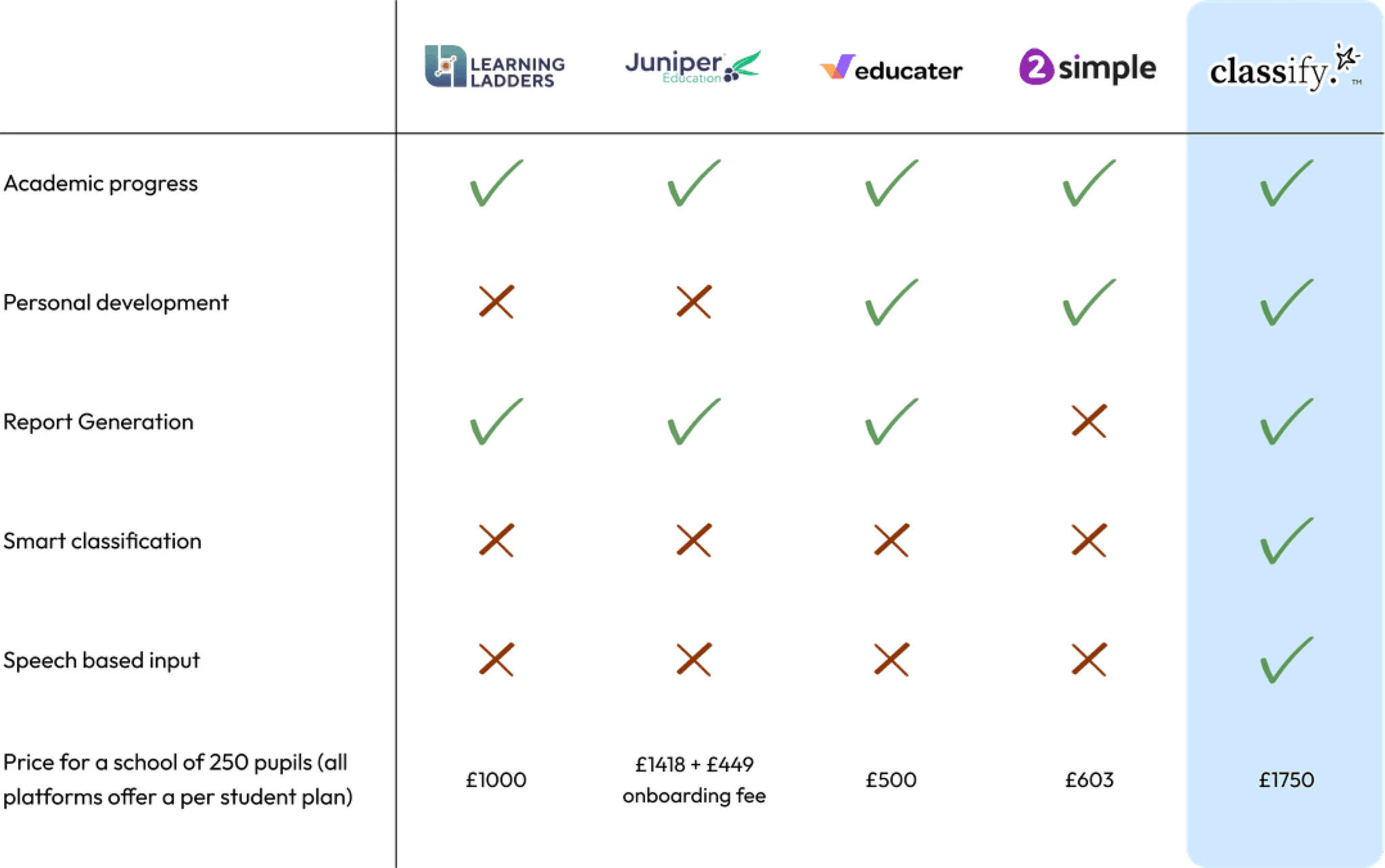
We carried out a competitive benchmarking activity to understand how Classify can fit in the landscape of educational softwares
We carried out a competitive benchmarking activity to understand how Classify can fit in the landscape of educational softwares
Key Findings
Key Findings
Clear opportunity for differentiation
Clear opportunity for differentiation
Classify can differentiate itself through the dictation and smart classification features - neither of which are provided by existing softwares
Classify can differentiate itself through the dictation and smart classification features - neither of which are provided by existing softwares
Competitive pricing advantage
Competitive pricing advantage
Classify offers broader functionality at a comparable or lower cost, strengthening its value proposition.
Classify offers broader functionality at a comparable or lower cost, strengthening its value proposition.
Early Validation & Industry Recognition
Early Validation & Industry Recognition
13
Beta Testers Signed Up
Beta Testers Signed Up
We have 13 teachers who are excited to be part of our beta testing cohort!
We have 13 teachers who are excited to be part of our beta testing cohort!
3
Pilot Schemes Confirmed
Pilot Schemes Confirmed
We have 3 primary schools who are ready to be part of our pilot scheme!
We have 3 primary schools who are ready to be part of our pilot scheme!

We are delighted to have been finalists in the Mayor’s Entrepreneurship and the AXA Startup Angel competitions in 2024!
We are delighted to have been finalists in the Mayor’s Entrepreneurship and the AXA Startup Angel competitions in 2024!
Reflection & Next Steps
Reflection & Next Steps
We are currently building our platform, ready for our first pilot - stay tuned!
We are currently building our platform, ready for our first pilot - stay tuned!